Joel White (Dundee): „The Logomachics of Artaud’s Theatre of Cruelty: The Theatre and its Double in the Light of Artaud’s Mexican Writings“

English / Hölderlin-Gastvorträge

Vortrag vom 21. Januar 2025

The question of Artaud’s politics has often been obscured by an unfair concentration on Antonin Artaud as a case study in madness. Up until recently, some of the most ex- plicitly political and philosophical writings of the French poet were hidden in an untranslated retranscription of his book Revolutionary Messages, written in Mexico in 1936. Published for the first time in September 2024, it not only allows us to reassess Artaud’s theatrical works through the lens of his explicit politics and engagement with figures such as Hegel, Bergson and Marx, but also provides what could be called the material Double to the spiritual and aesthetic endeavour that was to be the Theatre of Cruelty. In my presentation, I will read The Theatre and its Double alongside Revolutionary Messages to highlight how it is now possible to connect spirit and matter, demonstrating how many of the aesthetic ideals of the Theatre of Cruelty, such as its emphasis on the notion of the void, staging, and breath, are related to a political and philosophical vision of the world in which Life reconnects with Nature.

Joel White is a lecturer at University of Dundee and Staffordshire University. He is the executive editor of Technophany, Journal of Philosophy and Technology, a post- doc researcher in the ENERGY: A Philosophy of Practice project at Dundee University and a translator of the French avant-garde, having recently published Antonin Artaud’s Revolutionary Messages with Bloomsbury Academic. His work was published in the edited collection Contingency and Plasticity in Everyday Technologies (2022).
Karoline Gritzner (Graz): „Aesthetics of the Sublime in Contemporary Theatre“

English / Hölderlin Antrittsvorlesungen / Hölderlin-Gastvorträge

Vortrag vom 10. Dezember 2024

When the sublime became a category of art (in post-Kantian aesthetic theories), the problem of representation came to be reassessed and the category of the beautiful expanded. Modern theories of the sublime (e.g. Adorno and Lyotard) emphasise the process of de-subjectification in aesthetic experience and criticize of the rational control of nature. In this lecture, I question to what extent contemporary theatre may enable a thinking that approaches the philosophical-aesthetic experience of the sublime – how it may question it, interrupt it and develop it further. Using examples from Romeo Castellucci’s, Howard Barker’s and Jan Fabre’s art of theatre, I consider the sublime as a limit-experience, as a feeling of sensorial and intellectual intensity, and finally as an announcement of alterity, formlessness and transcendence, which nevertheless represents an immanent confrontation with the materiality of the image, the body, and language.

Karoline Gritzner is a theatre scholar with extensive experience of research and teaching in the fields of theatre studies and performance studies in the UK and Austria. She held a position as lecturer at Aberystwyth University, Wales, and is one of the founding members of the international, interdisciplinary research network Performance Philosophy. From 2019 until 2022 she led a FWF-funded research project on the topic of the sublime in theatre at the Centre for Cultural Studies at the University of Graz (2019–2022). Her publications include Georg Büchner’s Woyzeck (2019) as well as Adorno and Modern Theatre: The Drama of the Damaged Self in Bond, Rudkin, Barker, and Kane (2015).

Katalin Trencsényi (London): „Expanded Dramaturgies of Curating“

English / Hölderlin-Gastvorträge

Vortrag vom 11. Juni 2024

Starting from Marianne Van Kerkhoven’s ideas about micro and macro dramaturgy, the lecture explores the notion of curating beyond staging performances and shaping a repertoire and examines how festivals are creating “cultural gathering spaces” (J. Applebaum) and “spaces for dialogue” (H. Perry) outside the walls of their building, venturing into site-responsive, process-focussed, and interdisciplinary practices. For illustrating this move from product to process, from consumption of art to civil participation in local issues of concern, the lecture presents examples from the work of two festivals from the Nordic region of Europe. Based on research interviews – with art curator Taru Elfving, whose special interests are research-based practices, participatory and process-based approaches; Trevor Davis, director of Metropolis (Copenhagen), an “art-based metropolitan laboratory for the performative, site-specific, international art”, organised by Københavns Internationale Teater (KIT) which creates “temporary, mobile spaces”; and Hanna Parry, artistic director of Baltic Circle International Theatre Festival, who initiated the festival’s nature restoration project in Ähtäri in collaboration with climate and rewilding expert Snowchange Cooperative – the lecture seeks to find out what the guiding ideas and principles behind this new type of work are and how they are framed within an art festival.

Katalin Trencsényi (HU/UK) is an award-winning dramaturg, theatre-maker and researcher. Her areas of research are new- and expanded dramaturgies, dance dramaturgy, comparative dramaturgy, women and theatre, and political theatre. As a London-based dramaturg, Katalin has worked with the National Theatre, the Royal Court Theatre, Soho Theatre, Corali Dance Company, Deafinitely Theatre and with many independent artists. Katalin is the author of Dramaturgy in the Making. A User’s Guide for Theatre Practitioners (2015); editor of Bandoneon: Working with Pina Bausch (2016); co-editor of New Dramaturgy: International Perspectives on Theory and Practice (2014); and a contributor to several volumes and professional journals. Currently, Katalin is working as a lecturer on the Comparative Dramaturgy and Performance Research programme at the University of the Arts Helsinki.

Nadav Shofet (Tel Aviv): Standing Together – shared struggle, shared future: building power through Jewish-Palestinian solidarity

Digitale Theaterforschung / English / HTA-Ringvorlesung / Konflikte aushalten! – Check your privileges!

Guest of the second lecture in the lecture series “Enduring Conflict! Check Your Privileges!” was Nadav Shofet of the grassroots movement “Standing Together”. Standing Together is the largest grassroots movement mobilizing Jewish and Palestinian citizens of Israel in the fight towards an end of the occupation, peace, equality and social and climate justice. Nadav is a member of the national elected leadership of this movement and is the director of the Resource Development and International Department. Following October 7th, he took part in founding the Jewish-Arab solidarity guard in Tel Aviv-Yafo. He has a background in community organizing and LGBTQ advocacy. Nadav is also currently finishing a degree in Philosophy.

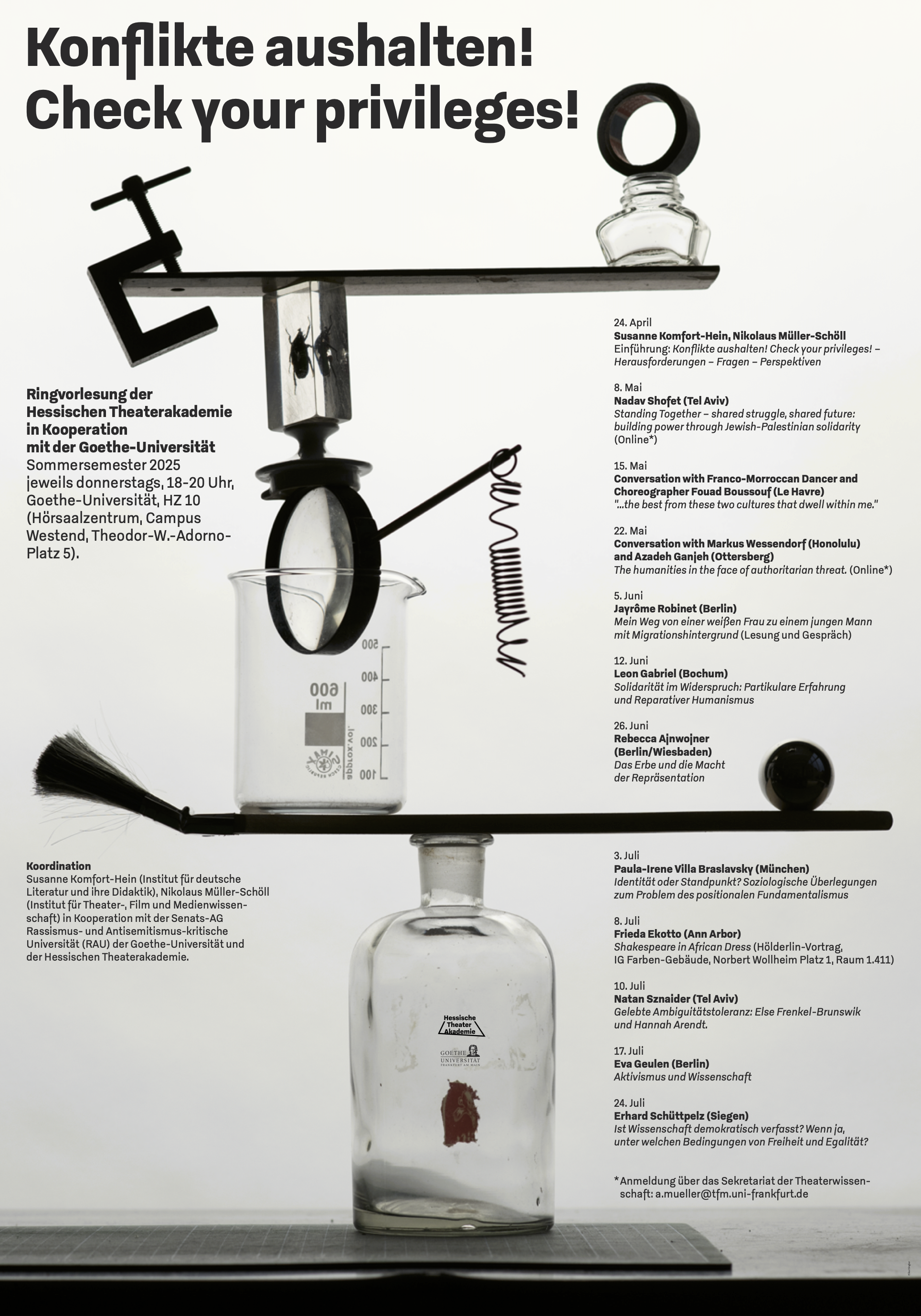
Konflikte aushalten! – Check your privileges!

Digitale Theaterforschung / HTA-Ringvorlesung / Konflikte aushalten! – Check your privileges!

Donnerstag, 18-20 Uhr, Hörsaalzentrum, HZ 10. Beginn: 24. April 2025

Konflikte aushalten! – Die Unfähigkeit, Widersprüche auszuhalten, so Else Frenkel-Brunswik und Theodor Adorno in ihrer Studie über den autoritären Charakter, sei als Schlüssel zur autoritären Persönlichkeit wie zu antisemitischen Ressentiments zu sehen. Check your privileges! Diese Forderung zielt auf die Problematik der Repräsentation und der Positionalität in den gegenwärtigen gesellschaftlichen Konfliktzonen. In diesem Zusammenhang erwarten diejenigen, die  in Theorie, in den Künsten oder im Aktivismus einen Safe Space einfordern, Schutz, der nicht lediglich den einzelnen Fall betrifft, sondern sich auf die gesamten institutionellen Gegebenheiten und Praktiken richtet.

Gemeinsam formulieren diese zwei Parolen das Spannungsfeld, dem sich die interdisziplinäre Ringvorlesung widmet. In einer Mischung aus Präsenz- und Online-Veranstaltungen wird sie die in vielen Debatten der vergangenen Jahre aufgebrachten, aber im Tagesstreit nicht hinreichend reflektierten Fragen intensiver untersuchen und die ihnen zugrundeliegenden Aporien in den Blick nehmen: Wie lassen sich das Recht auf freie Meinungsäußerung und die Wissenschaftsfreiheit mit dem Anspruch auf Schutz vor Diskriminierung unter Aspekten von ClassRaceGenderAbility und Agevereinbaren? Wie verhält sich Wissenschaftsfreiheit zu Meinungsfreiheit? Wo müssen Institutionen ihre Geschichte und Gegenwart, ihre Routinen und Praktiken unter dem Vorzeichen der Sensibilisierung für strukturelle Diskriminierungen kritisch reflektieren und verändern?

Die Ringvorlesung beschreibt in den zwei Teilen ihres Titels einen Konflikt, der mit besonderer Vehemenz in den klassischen Stätten der Öffentlichkeit ausgetragen wird: In Universitäten, Bildungsstätten, Theatern, alten und neuen Medien, Parlamenten und Gerichten. Sie zielt darauf ab, kultur-, medien-, sozial- und theaterwissenschaftliche sowie historische und politikwissenschaftliche Positionen zu den angeschnittenen Themen zu präsentieren. Dabei soll ein besonderer Focus auf die in vielen Streitfällen zu entdeckenden intersektionalen Aspekte der Diskriminierung gelegt werden. Gefragt werden soll nach produktiven Formen des Empowerments und der Gewinnung von Agency, doch zugleich auch nach Möglichkeiten des De-linkings und Unlearnings auf der Seite der durch strukturelle Ausgrenzung geprägten Institutionen.

Zur Vorlesungsreihe beitragen werden unter anderen: Rebecca Ajnwojner (Berlin/Wiesbaden), Fouad Boussouf (Le Havre), Leon Gabriel (Bochum), Eva Geulen (Berlin), Jayrome Robinet (Berlin), Erhard Schüttpelz (Siegen), Natan Sznaider (Tel Aviv), Paula Irene Villa Braslavsky (München).

Koordination: Susanne Komfort-Hein (Goethe-Universität), Nikolaus Müller-Schöll (Goethe-Universität) in Kooperation mit der Senats-AG Rassismus- und Antisemitismus-kritische Universität (RAU) und der Hessischen Theaterakademie.

Jasper Delbecke (Gent) „Tracing the Essay in Performing Arts. Five Essay Pieces“

Hölderlin-Gastvorträge

Vortrag vom 14.05.24

The talk will expand on the emergence of “the essay” as a form, concept, and method within the field of performing arts during the mid-2010s. Drawing inspiration from the rich tradition of the literary essay and informed by the contemporary proliferation of the essay form across cinematic (essay film), photographic (photographic essay), installation-based (essay-installation), and exhibition-related (essay-exhibition) domains, Delbecke dissects the reasons behind and manifestations of this form within the field of performing arts during this specific era. Through the lens of five distinct artistic practices – those of Muraya Ogutu, Silke Huysmans & Hannes Dereere, Ho Rui An, Mobile Akademie Berlin, and Jozef Wouters/Decoratelier – Delbecke scrutinizes the formal elements present in these works. Furthermore, he examines in study how artists turn to the essay form and/or adopt an essayistic mode of working in response to the activist imperative prevalent in socially and politically engaged forms of theatre, performance, and the broader arts landscape since the turn of the millennium.

Jasper Delbecke is an art and theatre scholar whose academic work attests to a curiosity in how the (performing) arts deal with past events and the politics of representation of personal, local, national or global histories. From this interest, he has a scholarly fascination with innovative forms of documentary theatre, new modes of storytelling, the format of the lecture performance and the conceptualization of (semi-)fictive exhibitions or museums. In August 2023, Delbecke obtained his doctoral degree in Art Studies in August 2023 at Gent University, having previously earned his Bachelor of Arts in Art Studies (2013) and Master of Arts in Art Studies (2014) at the same institution. In 2010, he finished his Professional Bachelor in Education, specialising in history and arts at Artevelde Hogeschool (Gent). From October 2023 until January 2024, Delbecke serves as a part-time guest professor at the Department of Art History, Musicology, and Theatre Studies at Gent University.

Krassimira Kruschkova (Wien): „Das unfassbare Archiv. Eine Soloperformance von Arkadi Zaides im Kontext des zeitgenössischen Tanzes“

Hölderlin-Gastvorträge

Vortrag vom 06.02.24

Arkadi Zaidesʼ Choreographie Archive (2014) fokussiert das Camera Project des israelischen Informationszentrums für Menschenrechte in den besetzten Gebieten B‘Tselem, das Videokameras an Palästinenser:innen verteilt, um eine kontinuierliche Dokumentation von Menschenrechtsverletzungen zu ermöglichen. Das gewählte Filmmaterial zeigt ausschließlich israelische Soldaten, Siedler, Aktivisten in verschiedenen konfrontativen Situationen. Die filmenden palästinensischen Menschen bleiben abwesend, hinter der Kamera, anwesend sind allerdings ihre Bewegungen, Stimmen, Standpunkte. Es geht um den paradoxen Absenz/Präsenz-Modus der Archiv-Praxis und – wie der Vortrag auch mit anderen künstlerischen Beispielen (von Meg Stuart, Rabih Mroué, Walid Raad, Francis Alÿs, Shaymaa Shoukry, Jonathan Burrows/Matteo Fargion u.a.) vorschlägt – um die situativen Paradoxe der Poetik und Politik von Performance heute.

Zaides beteiligt seinen Körper kritisch am kollektiven Bewegungsmaterial seiner israelischen Gemeinschaft, indem er Gesten und Bewegungssequenzen, die er als Filmprojektion nochmals archiviert und aktiviert, immer wieder stillstellt und nachstellt, simultan zum Filmmaterial und dann auch separat, ohne die Filmprojektion. Sein Re-enactment erinnert und prüft, probt zugleich den Kontext – einmal, zweimal, mehrmals –, indem er die filmische und narrative Perspektive immer wieder wechselt, unterscheidet, kritisiert. Indem er derart die Komplexität und Unfassbarkeit des Konflikts darstellt, stellt er seine Undarstellbarkeit aus. Indem er niemals dasselbe wiederholt, wiederholt Archive die Differenz selbst und öffnet jede performative und figurative Position, Positionierung, Perspektive ins Plurale. Die Ambivalenz der Filmsequenzen – gerade in ihrer puren Bild-Faktizität – wird von Zaides choreographisch differenziert: Derart von der Situation abgeteilt, wird er – wie wir – Teil davon.

Krassimira Kruschkova ist Tanz- und Performancetheoretikerin. Seit 1995 Lehre an der Universität für angewandte Kunst und an der Akademie der bildenden Künste Wien. 1994 Promotion und 2002 Habilitation an der Universität Wien. 2003-2017 Leiterin des Theoriezentrums am Tanzquartier Wien. Mehrfache Gastprofessuren an der FU Berlin, an den Universitäten Wien und Salzburg. Kuratorin zahlreicher Vortrags- und Performancereihen. Publikationen u.a.: Hg.: Ob?scene: Zur Präsenz der Absenz im zeitgenössischen Tanz, Theater und Film (2005), Mithg.: Tanz anderswo (2004); It takes place when it doesn’t. On dance and performance since 1989 (2006); Dies ist kein Spiel (2008); Uncalled. Dance and performance of the future (2009); 8 booklets SCORES #0-#7 (2010-2017).